

Summary #
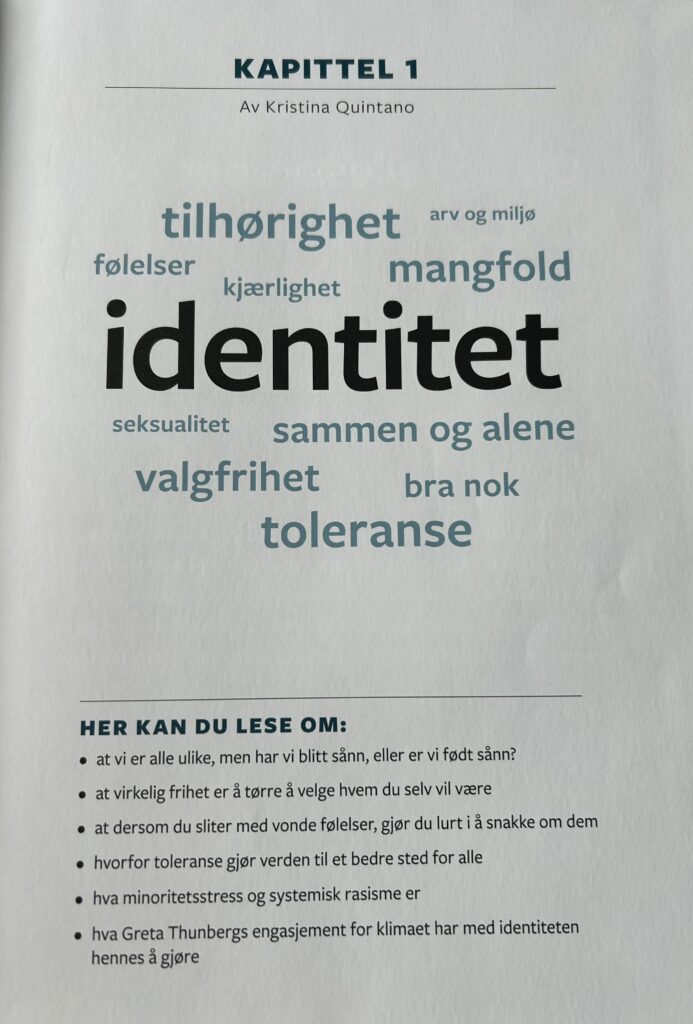
Chapter 1 is about what shapes our identity – with an emphasis on belonging, diversity, emotions, sexuality, tolerance and the freedom to be oneself. Students learn that identity is developed in encounters with others, and that it is important to stand up for one's own choices and accept differences.
Gender identity and sexual orientation are presented as innate and personal characteristics, and references are made to books that convey that one can be "born in the wrong body" and need medical help to live in line with one's perceived gender. The emphasis is on supporting and affirming such identity expressions, without room for critical questions or alternative understandings. It promotes a view where gender and sexuality are emotionally based and detached from biology and other higher purposes. The chapter builds on queer theory and sex-positive philosophy in the understanding of sexuality and gender.
It gives a one-sided and ideological picture of identity – where personal freedom and feelings are at the center, and where children and young people are not helped to understand themselves in light of truth, biology or relational responsibility. Instead of security and clarity, it opens up to confusion and pressure to define oneself based on feelings and external expectations, that the truth is found within oneself and that it must be lived out in order to have good sexual health. It is sexological theory that forms the basis for such an understanding.
Competency goals:
- Reflect on who we are and what shapes our identity
- Show respect for the fact that people are different
- Exploring why someone experiences discrimination or racism
- Talking about choice, freedom and what influences meaning and action
- Use sources and think critically about the information you receive
Chapter 1: Identity #
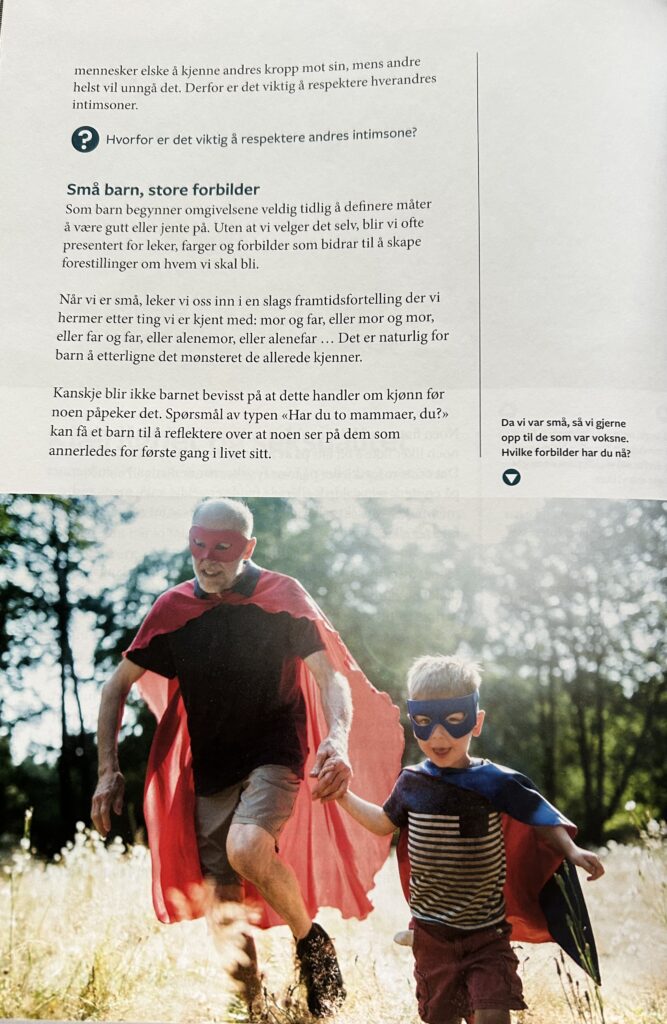
Here we see how the textbook conveys that children are shaped by their surroundings at an early age, and that gender roles and understanding of family are something that should be questioned. It is suggested that children must be freed from traditional frameworks, such as "mother and father", and rather be given the freedom to choose for themselves who they want to be and imitate - regardless of gender and family type.
Although the message is about supporting children in being themselves, the text lacks the value of biological gender, and biological belonging and the right to be raised by and cared for by a father and mother, whose unique role and security lie within a clear framework as the best starting point for an upbringing. Children do not need to be confused to “become free” – they need to be affirmed in who they are in their biological gender.
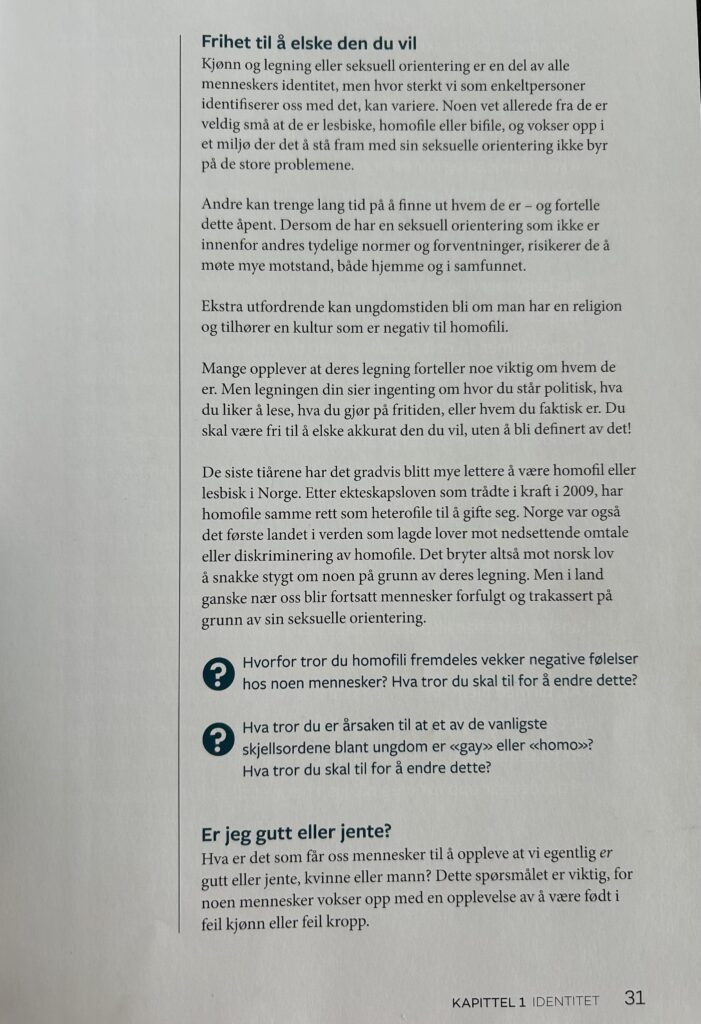
The text continues by emphasizing that gender and sexuality are part of the identity we must find for ourselves, and that freedom is about being able to love who we want and be who we feel like. At the same time, all other understandings of gender and sexuality – especially those based on biology, faith or traditional values – are portrayed as narrow and exclusionary. “Adolescence can be extra challenging if you belong to a religion or culture that is negative towards homosexuality”
The concept “born in the wrong body” is introduced without critical reflection, and it is suggested that it is common and right to change gender if one experiences discomfort or anxiety. No questions are asked about why more and more young people feel alienated from their bodies, or what consequences hormone treatment and surgery can have, and that this is considered “experimental treatment”. Instead, the feeling is confirmed as the truth itself, this is queer theory applied to understand man in a new and radical way.
What starts as a message of tolerance ends in a one-sided portrayal where gender is fluid and sexuality is uncontested. Students are not given the space to reflect on biological sex, development, and what provides lasting security in identity.
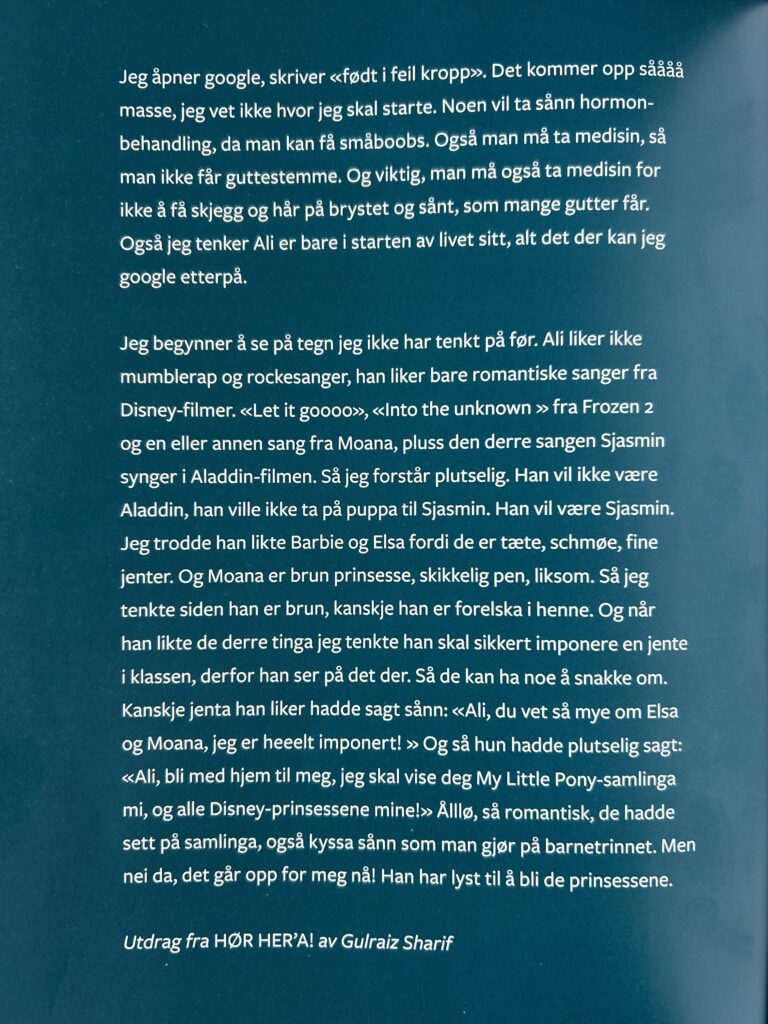
This text builds on the theme of gender and identity, and is an excerpt from the novel Listen here! where the narrator explores the idea of being «born in the wrong body.» The story conveys how a boy begins to think that he might be a girl because he likes romantic songs, princess characters, and feels different from other boys. Here you can see a clip from the film to see how uncritical gender understanding is conveyed to children.
The text uses personal and emotionally driven language to normalize the idea that interests and personality can mean that one is actually of the opposite sex. This builds on a worldview where gender is defined by feelings and preferences, and not by the body one is born with. It conveys that medical gender reassignment – through hormone therapy and surgery – is an available solution, without mentioning the consequences, ethical dilemmas or biological realities.
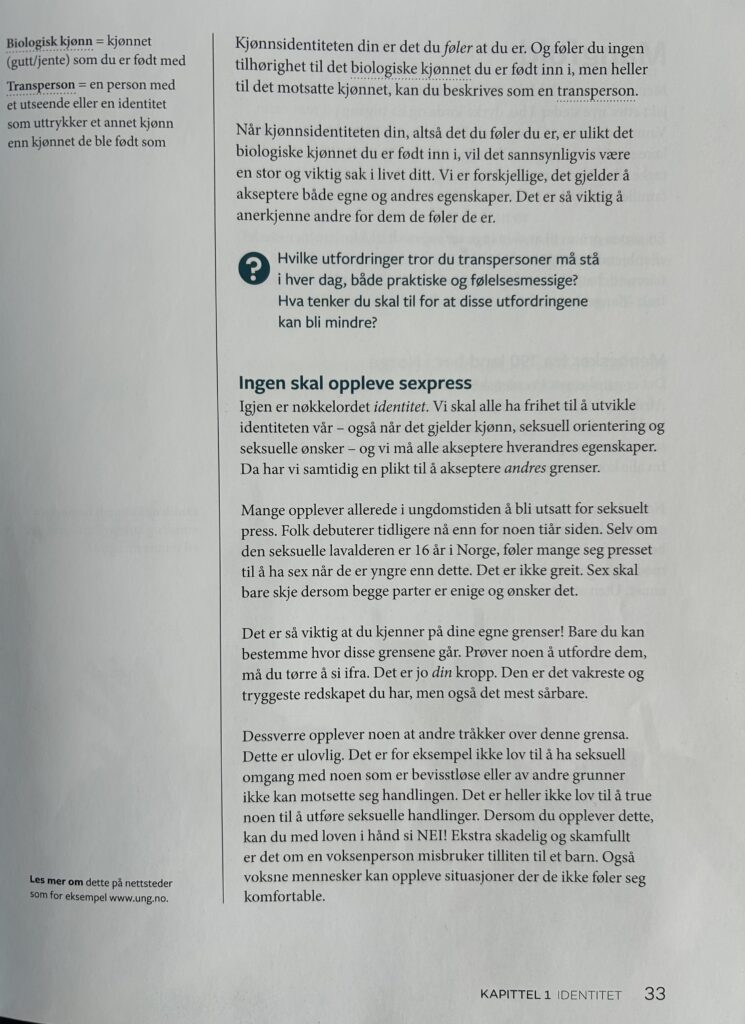
The chapter continues the message that gender is about how you feel you, not the gender you were born as. Biological sex is briefly mentioned, while great emphasis is placed on the fact that gender identity is subjective and must be recognized by others – regardless of what the body says. Trans is referred to as a personal expression, without any critical reflection on medical or long-term consequences. And it is implicitly stated that a person who experiences themselves as a different gender should be confirmed by the students with the “correct use” of pronouns. In other words, that men who experience themselves as women should be referred to as “she”.
At the same time, an important theme about sexual pressure and boundaries is raised: that no one should be pressured into something they don’t want to do, and that “no is no”. This is a good and necessary message, but it contrasts with the previous content of the chapter. Students are told that they should be confident in themselves – but at the same time they learn that identity is fluid and based on emotions. When the self is made limitless and gender becomes optional, it becomes more difficult to give children the security and anchoring they need. This is a confusing chapter.


