
Chapter 6: Sexuality - identity, body and emotions #
Summary #
Like several other teaching aids and consistently from the Aschehough and Arena series, we see that a fluid approach to gender is dominant when sexuality and identity are themes that are in focus. Gender is conveyed as being the students' experienced sense of themselves. The textbook presents two conflicting views of gender, "biological sex" and "gender identity", which students must understand correctly - that is, queerly. The bottom line is that what you feel like, you are. The book states that "you can experience being a man, a woman, both or neither".
After explaining biological sex, it is claimed that “for humans, gender is not that simple”. The unscientific concept of «gender identity» is presented as something everyone has, that sits in their heads, and that everyone must relate to, redefining and disregarding biology and science. The book also presents the expression «born in the wrong body» in connection with gender incongruence. It must be confusing for students to relate to queer theory and biology in an unscientific mix, where emotions rule and biology must be subordinate to gender identity.
About the textbook #
Key competence goals:
✓ Discuss issues related to sexual and reproductive health
Interdisciplinary topics:
✓ Public health and life skills

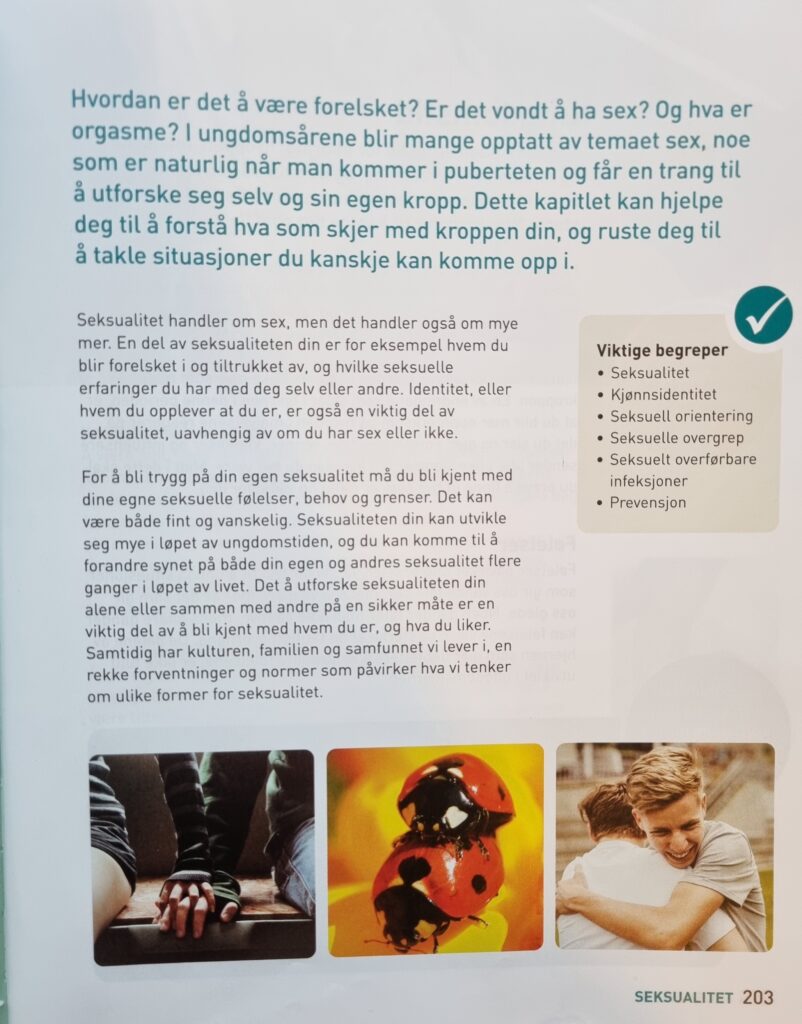
The chapter touches on falling in love, emotions and sex. The textbook mentions that «Sexuality is about sex, but it is also about much more.» In connection with sexuality, gender is also a topic that is addressed, and like other new textbooks on this topic, different views on gender are conveyed.
When it comes to the «Important concepts» that will be reviewed in the chapter, it is interesting to see that it is precisely the concept of «gender identity» that is emphasized. This is also seen in the vocabulary library at the back of the book, «gender identity» is mentioned, but not the concept of «gender». «Gender identity» therefore appears
as the determinant of what gender one is.
Identity #
In connection with identity, it is emphasized that adolescence is a period in which many experience
uncertainty. It is clear that this is the situation for many, and that puberty becomes an extra vulnerable
phase. But it is disturbing that there is a great focus on uncertainty related to gender.
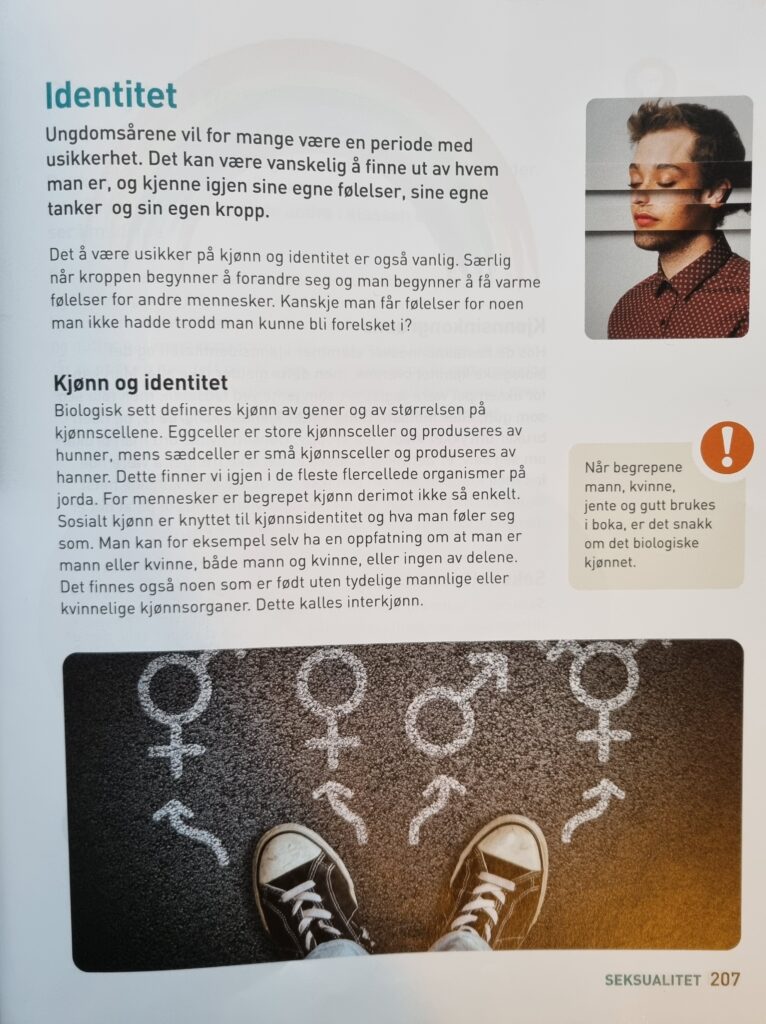
The textbook presents different ways of understanding gender: Biologically, gender is defined by genes and
size of gametes. But the textbook clarifies that for us humans the concept of gender is not
so simple. Social gender is then presented, which is linked to gender identity (what one feels
themselves as).
Intersex is also mentioned, and is presented almost as a separate gender category. There are
people who are born with unclear gender characteristics, but this is not an argument against a
binary division of gender.

Note that the textbook specifies the following:
When the terms man, woman, girl and boy are used in the book, we are talking about biological sex.
Gender is thus conveyed in different ways, understood from the perspective of biology, and understood from one's own perspective.
experience of who one is. The teaching materials no longer provide a definition of what a woman and a
man is.
Your new body #
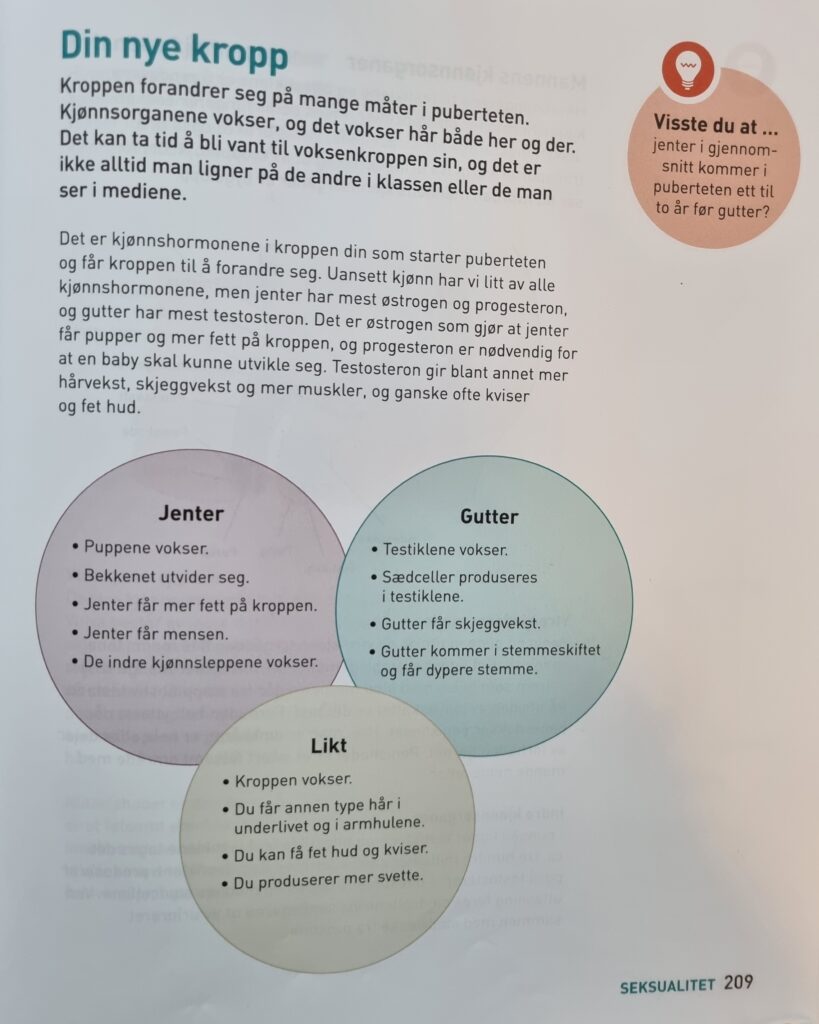
The textbook discusses what happens to the body during puberty. But before this explanation of what
what happens to the girl's and boy's bodies, the textbook has specified up front that when these concepts
further used, it is about gender understood from the perspective of biology. The textbook does not present a
answer to what gender is, but instead points out that the concept can be understood in different ways:
Summary #
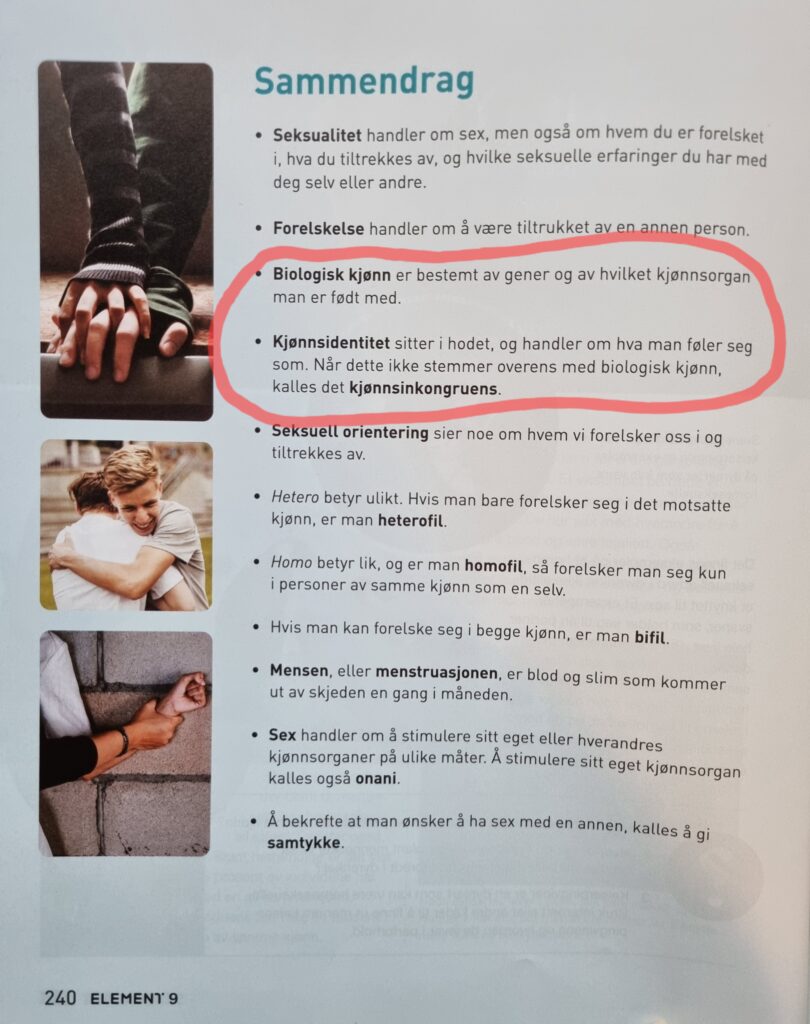
The summary provides a summary of how gender has been presented in the chapter - gender
understood from biology, and gender understood from the concept of "gender identity" (gender is in the head and
is about what you perceive yourself to be).


