
Chapter 2: Who am I? #

Summary #
Students are introduced to a variety of queer terms, from “gender norms” to “gender identity” and “transgender”. The book addresses imagery, celebrities and concepts to cement students“ understanding of how gender and sexuality should be understood. Pride is communicated uncritically as something everyone should celebrate, and is directly linked to ”gender identity“ and ”sexual orientation”.
Kim Friele is used as an honorary person in the book, but an article in Aftenposten reveals that Friele believed that “pedophilia” was the same as “homosexuality”, just a different sexual orientation. Friele ensured that “pedophilia” was incorporated into the Fri Association. One could well say that this is deserving of criticism, and something that students should know about before praising Friele’s fight for rights.
The book spends a lot of space on conveying gender and identity and sexuality in a way that is completely in line with sexology and queer theory, it is done uncritically: “As long as you know what gender you are, no identity is wrong,” it says. The book has a title that says that “it can be difficult to find out what gender you are.” This says a little about the level of this ideological thought conveyed in Refleks 7.
Key competence goals:
- Explore different aspects of diversity in Norway and reflect on people's needs to be themselves and to belong in a community.
- Discuss what equality and gender equality mean for a democracy, and develop suggestions for how to combat prejudice, racism and discrimination.
- Reflect on variations in identities, sexual orientation and gender expression, and one's own and others' boundaries related to feelings, body, gender and sexuality, and discuss what can be done if boundaries are violated.
Interdisciplinary topics:
- Public health and life skills
- Democracy and citizenship
What is identity? #
Comment: The chapter has a strong focus on identity. This is a complex concept and gender identity and sexual orientation have become central concepts that are addressed in addressing the theme. #
It is reprehensible that the word “personality” is not mentioned in a chapter called “Who am I?” Instead, students learn that “personal identity” is what makes you exactly who you are. And what does the book say? Well, your appearance, you are what you like, what you have in terms of knowledge, your attitudes and values. The textbook does not mention personal qualities or personality.
This is, to put it mildly, a lack of description of a human being, and psychological literature explains that our identity is changing throughout our lives. While the textbook says that you are your own taste, without saying that taste can change drastically over the course of a lifetime.
The book also talks about “community identity”, and that our personal identity is shaped by our community identity. In the same sentence, the textbook states that “we can talk about Norwegian identity, class identity, religious identity and gender identity”. The textbook tells students that they are composed of personal identity and community identity, and that is who they are. These are complicated questions even for adults, and the textbook can give a misleading and incomplete picture.
Gender identity and sexual orientation #
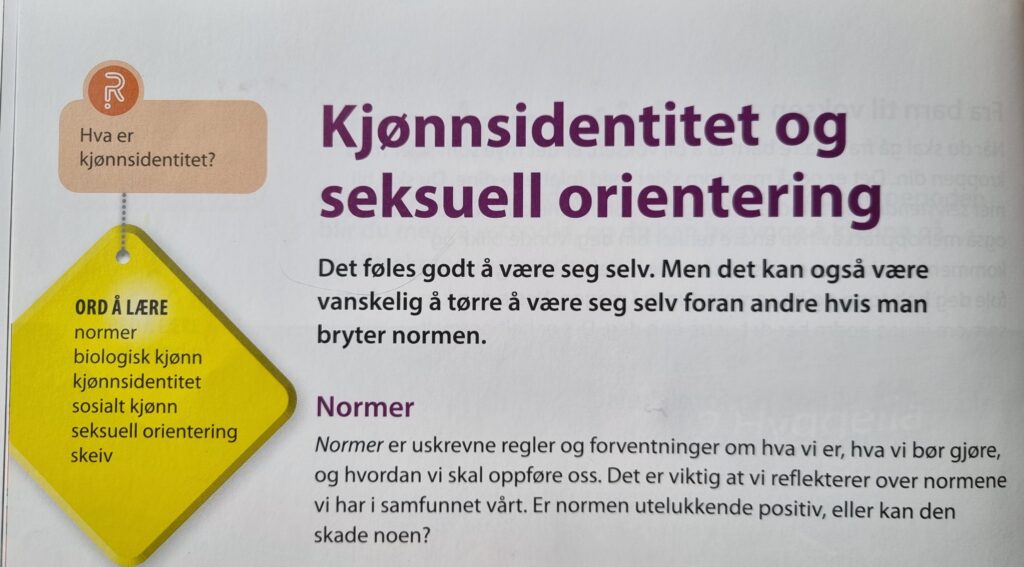
Commentary on textbook content (part 1) #
This chapter focuses on identity. It addresses different forms of identity in the interaction between the individual and the community. Identity is a complex concept, and both in the culture we live in and in the content of the teaching materials, one sees that gender identity, among other things, has been given a large place.
Note the question students should think about regarding norms: “Can the norm in society harm someone?” Here lies the implicit answer, yes, because what is called the heteronorm is claimed to harm queers, therefore one must practice norm criticism. The heteronorm is that society is based on everyone being either male or female and living in heterosexual relationships. Children should learn that this is wrong, and that there is no preferred norm or family composition.
Overfocusing on gender identity:
The focus in this textbook, but also in many other teaching materials about identity, is on allowing the student to create their own identity, by allowing you to decide who you will be. In this, both children and young people are "required" to reflect and think about issues they initially feel safe about. This applies to both sexual orientation and gender identity. In connection with the identity team, gender identity and sexuality have become important identity terms.
The teacher's guide also emphasizes that the fight to be who one is is also a political fight. The textbook shows examples of people who have been champions of increased tolerance and equal treatment, including Kim Friele and Emma Ellingsen.
Once again we see a textbook with a strong focus on LGBTQ issues.
Gender identity #
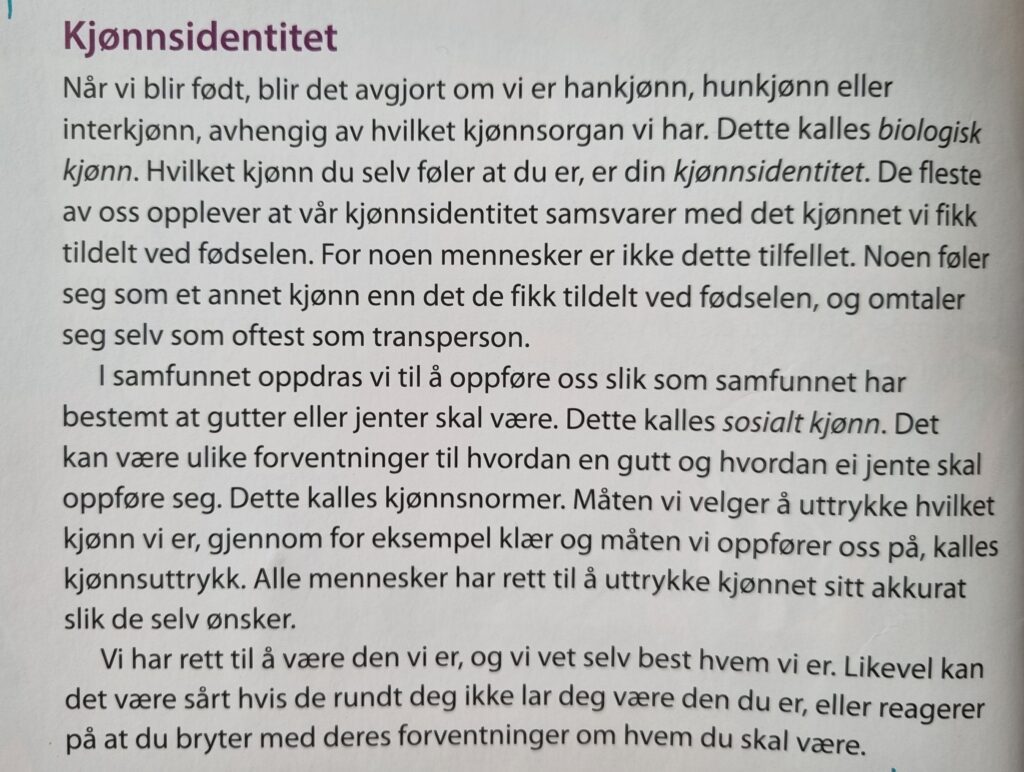
Commentary on the textbook on gender identity #
Under the heading “gender identity”, the textbook states that the student knows best who they are – which is directly linked to the queer theory that the gender you feel you are, that is you. This is connected to the fact that personality has fallen out of what defines a person, and identity –> personal identity –> gender identity, this is known only to the children themselves and no one else. What they feel they are, that is them. If you feel non-binary, then you are non-binary. The textbook states that this is the truth about gender – but this is radical and stems from something called queer theory, from queer theory. It is not scientific, in fact queer theory rejects science. Feeling determines what gender you are, not biology.
Furthermore, we see in the sections that norm criticism is exercised that girls and boys should be in a special way, called social gender and described as gender norms. Here, children are to learn to break with all expectations of gender, under the theory that children are blank slates and which gender they are has no effect on their lives. This is not true, as we see that in Norway, which is the world's most equal country, through politically introduced measures, care professions and professions with relationships with people have mainly female employees and applicants for education, while in professions with things and systems, mainly men have applied. Ergo, it means that there is something fundamental in our genders that is different from the other and is expressed in the choices we make.
Sexual orientation and pride #
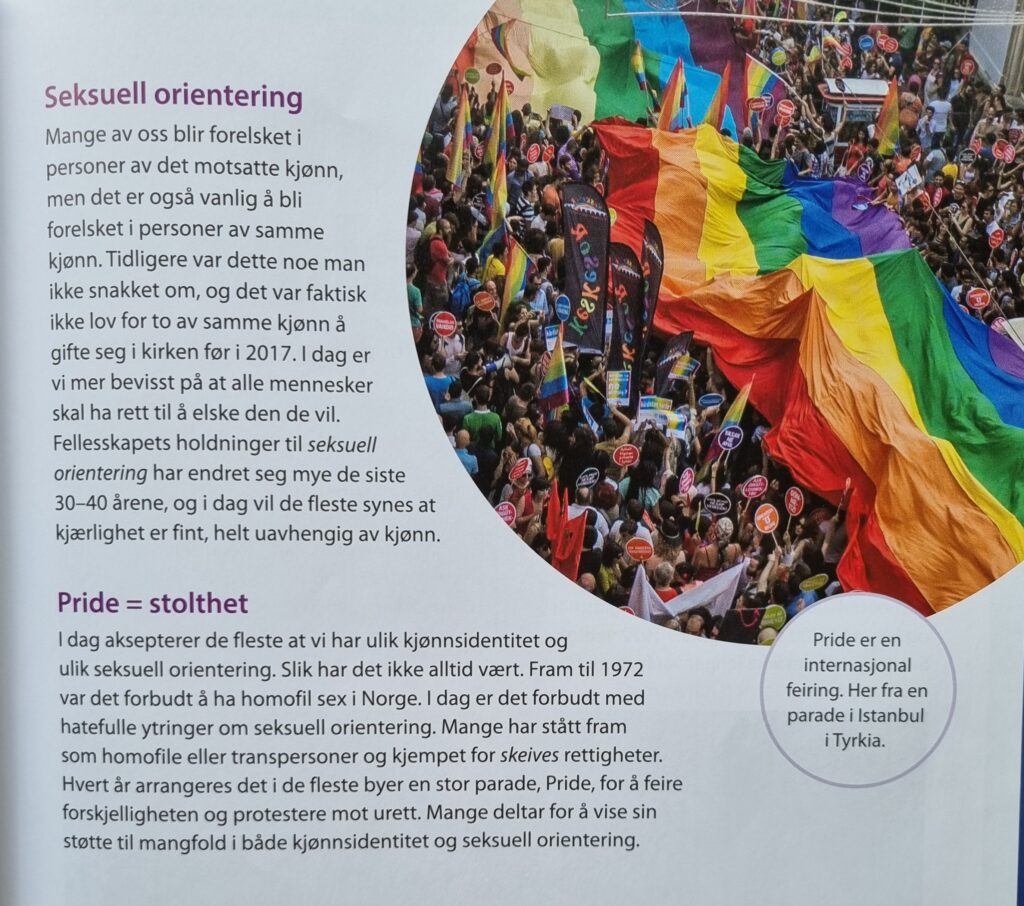
In connection with identity, gender identity and sexual orientation are presented as important identity terms (pp. 42-43). These concepts are also very central to the Pride content students encounter at school.
Commentary on sexual orientation and pride #
In this short text, all forms of cohabitation are normalized, and it is implicitly conveyed that Christians were the problem with bad attitudes that held them back, and that only a few care about gender in marriage. In addition, a rights rhetoric is repeated in the textbook, where it says that “everyone has the right to love who they want” and “everyone has the right to be who they are”, but these are not enshrined human rights. Even though it is communicated as rights without being so, it teaches children a way of thinking without limitations as protected rights. For example, “everyone”, meaning absolutely everyone, can love who they want without limits. This is not true. It is neither legal nor possible nor desirable.
Pride and gay sex
In this section, 11-12 year olds learn about gay sex as it is written in the book. Gay sex is communicated as a right that was not previously legal – and gay sex is normalized, and pride is communicated as a protest against injustice against queers. The children learn arguments for going to pride, that it is to show support. But even the Storting does not mark pride, because pride is a political celebration. This should have been made clear in the school book, and the fact that queer interest organizations are still fighting for “rights” that challenge the heteronorm. Free sex purchase, pimping, surrogacy, self-chosen parenthood among X number of people who choose to live together, which is called the chosen family.
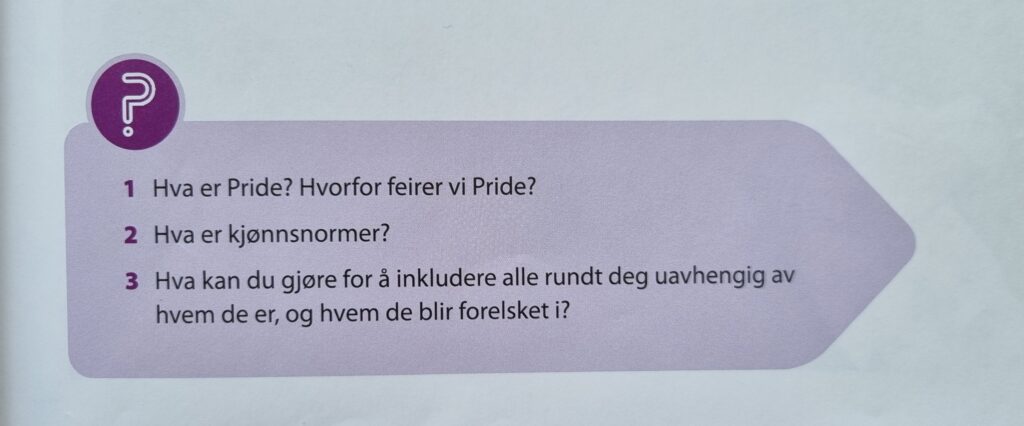
Assignments related to Pride are formulated in such a way that it is taken for granted that this is a celebration that everyone supports. Pride is presented as exclusively positive, and no textbooks problematize this theme in any way.
Commentary on textbook content (part 2) #
Norms are one of the focus words in the chapter. Students should be taught to be critical of norms, and reflect on whether they are exclusively positive, or whether they can be harmful.
The textbook focuses on gender identity., i.e. gender understood as self-perceived gender. Students encounter concepts that refer to different ways of understanding gender: gender identity, biological sex and social gender. In connection with biological sex, one sees that the well-known concept assigned at birth used.
The chapter also addresses different expectations of gender that one may encounter in society. Students are explained that they can express their gender however they wish, so-called gender expression, and that Everyone has the right to be who they are and express their gender exactly as they wish.. This statement also contains the idea and the political battle (for queer interest organizations) that this right also includes the right to undergo so-called gender-affirming treatment precisely to achieve the desired gender expression.
Sexual orientation is also the main focus of the chapter.. The term refers to who we fall in love with and are sexually attracted to. The textbook uses norm-critical language. The heteronorm should not be understood as the dominant norm. Nothing should be presented as more common than anything else. So even though heterophilia is the most common, formulations such as «"Many of us fall in love with people of the opposite sex, but it is also common to fall in love with people of the same sex"» (p. 43). Nothing should be conveyed as a natural starting point, neither in connection with gender identity nor sexual orientation.
Pride is a theme that opens up for teaching about gender identity and sexual orientation. Students then encounter the idea of multiple genders, the idea of being born in the wrong body, and the fact that you can choose what you want to be and that there are many alternatives. By making Pride a theme in the classroom, it opens up both a fluid approach to gender and sexuality, but also an expectation that this is exclusively something positive that should be celebrated. The current situation in the school, however, is such that both the student group, parents, teachers and school management are divided in their views on Pride, and the place the celebration and the theme have been given in the school.
Diversity, inclusion, community and equality are a natural and important part of everyday work in schools. However, this does not mean that Pride should be celebrated or be part of the teaching.
In connection with this theme, the main emphasis is precisely on gender identity and sexual orientation. And Pride is a celebration of so-called gender and sexual diversity.
In the section on Pride, we read that "today most people accept that we have different gender identities and different sexual orientations". This statement conveys that most people now accept that gender identity should be able to determine what gender is, and that everyone should submit to the prevailing view. It is clear that one should respect others' experiences of what or who they are, but one cannot impose either schoolchildren or others in the population to submit to a view that they do not themselves stand for.
It is mentioned that both homosexuals and transgender people have fought for queer rights. This also highlights the political side of Pride. Pride is about political issues, as mentioned in the comment above. One should recognize the right of others to have a certain view of gender and sexuality. Everyone should also have the right to fight for the political issues they are passionate about, including queer people. Nevertheless, it would not be right to force Pride celebrations in schools, as many disagree with
Both in terms of the political issues raised by queer interest groups during Pride celebrations, and not least through the fluid view of gender and sexuality that is emphasized in the teaching materials on this topic, it is clearly a problematic topic. This is clearly evident in the fact that students, parents, teachers and school management are divided in their approach to Pride, and have very different opinions about what place both the theme and the celebration should have in schools.
Teacher's Guide mentions in connection with Pride that even though it has now become legitimate to be queer, this has been a long political struggle. Since many still choose to hide their sexuality and gender identity, openness around this is important. According to the teaching guide, it is important to create awareness that queer rights have been a political struggle. Caring for and demonstrating tolerance for queer rights is therefore important.
Kim Friele and Emma Ellingsen #
-Advocates for queer rights #
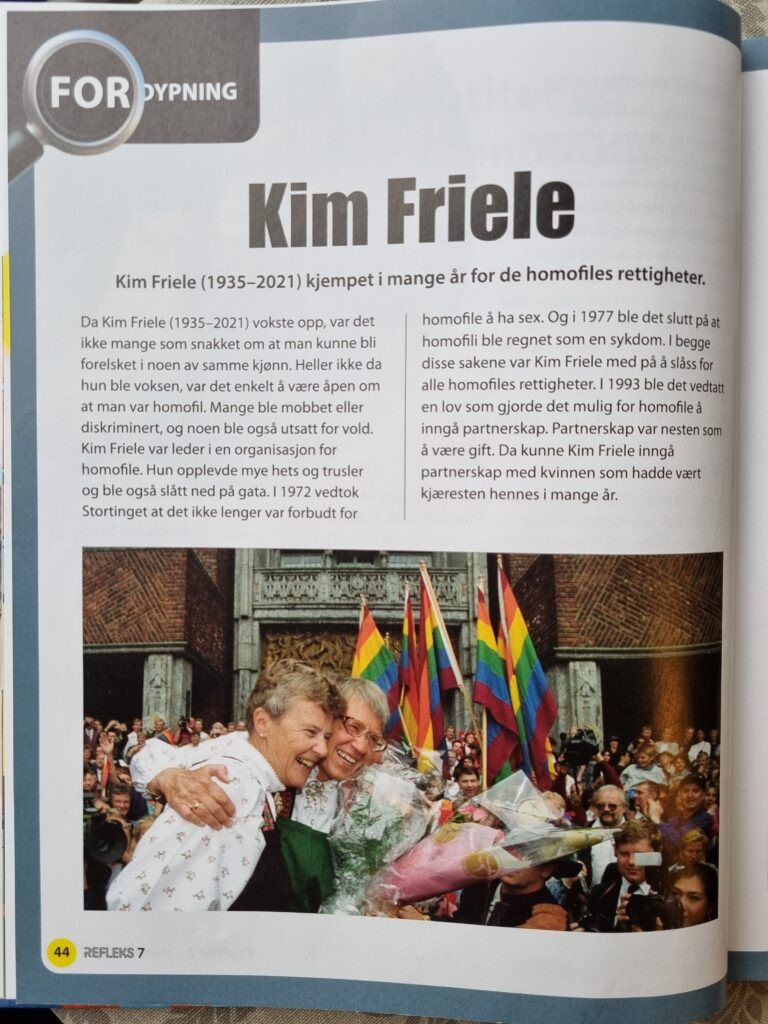
Kim Friele is presented as Norway's foremost advocate for same-sex relationships, but Friele has also suggested that pedophilia has similarities to the gay rights movement.
Commentary on textbook content (part 3) #
Kim Friele is presented as a great role model, and a champion for gay rights and leader of what is today the “Free Association”. What is not mentioned is the revelations in Aftenposten with the headline: “When pedophiles were caught in the heat“
From the case: "Pedophiles must show pride in their feelings! Don't let yourselves be cowed!" Friele said and received great applause, according to the minutes in the association's members' magazine. Friele is also said to have compared the pedophile liberation with the homosexual liberation and said that the two had many similarities. Among the others who gave speeches was psychologist Thore Langfeldt, later known as an expert and therapist of sex offenders.
Foreningen Fri will only have this in 2023 issued a statement of regret. Kim Friele was the leader of DNF-48 from 1966–1971, and served as secretary general until 1989. DNF-48 and several other organizations were united in the National Association for Lesbian and Gay Liberation (LLH) in 1992. In 2016, LLH changed its name to FRI – the association for gender and sexual diversity.
One can therefore say that there are objectionable conditions at Friele that are being fostered, and that it is easy to turn a blind eye to the fact that "all love is true love.".
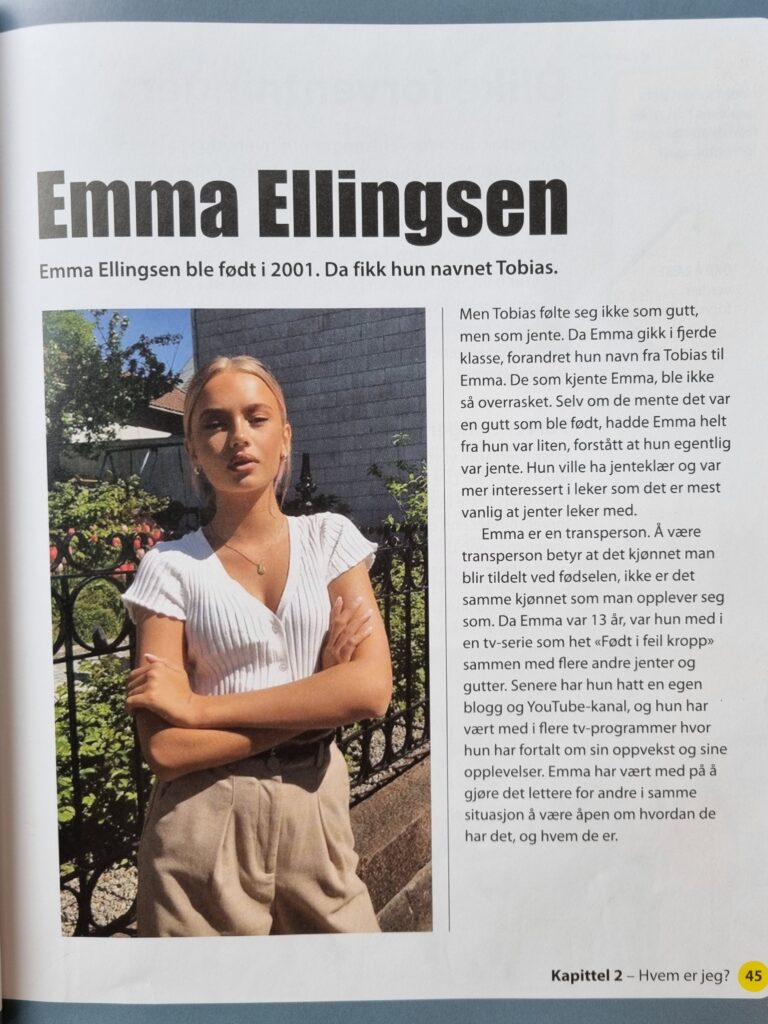
Emma Ellingsen is a well-known influencer and a champion for transgender rights. Through Emma's story, students are introduced to the idea of "born in the wrong body." Emma has undergone so-called gender-affirming treatment and surgery, and is open about this topic on social media. Here, an uncritical picture of such treatment emerges.
Commentary on textbook content (part 4) #
Textbooks often present personal stories from transgender people in textbooks that deal with gender identity. In this textbook, Emma Ellingsen is presented. The stories present a view of gender where gender identity is the determining factor. It is an idyllic picture that students get of people who have undergone so-called "gender-affirming treatment.".
Students are introduced exclusively to the stories of transgender people who express that they are living well with the irreversible medical and surgical treatment they have undergone. Emma is presented as a great role model for her openness about gender identity.
The textbook also mentions series Emma has participated in, and Emma's YouTube channel. On social media, there is often an idyllic image that children and young people get of undergoing so-called gender-affirming treatment. It is frightening that it is often presented in an uncritical way, and as a good solution. This is very reprehensible and serious with the potential for irreversible consequences for children who believe it.
This also applies to the production in several textbooks
Prejudice and discrimination #


comment on textbook content #
The textbook addresses the topic of prejudice. This is explained as having perceptions about others that are not actually true, and that prejudice is a result of a lack of knowledge. This premise is deserving of criticism, especially if we look at the social debate around pride and gender. There we experience that former Minister Anette Trettebergstuen at The debate on NRK says that “children and parents lack knowledge and have bad attitudes” if they are critical of pride and do not want to celebrate pride.
It is often an argument used in connection with criticism of the new view conveyed in schools about gender, criticism of a fluid approach to teaching about gender and identity, and criticism of Pride as a celebration and theme in schools.
Norwegian legislation is mentioned in connection with prejudice. The law states that no one should be discriminated against because of gender, religion, sexual orientation or skin color.
Chapter assignments #
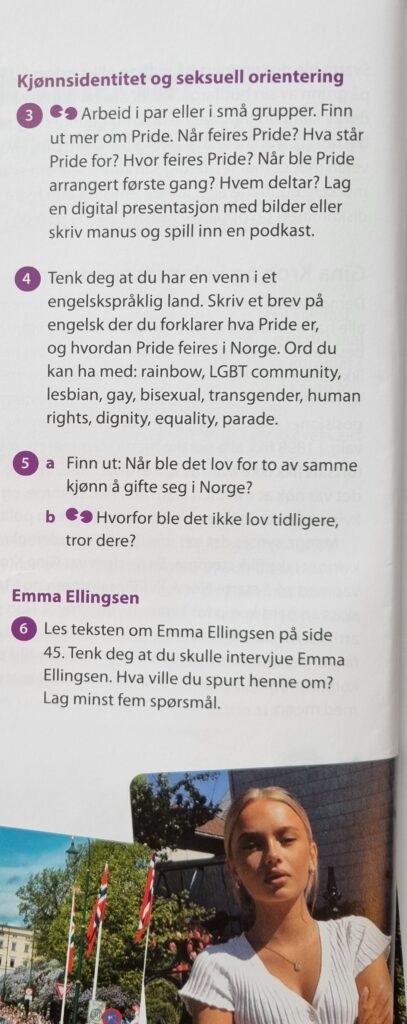
Here are examples of assignments for the chapter, "Who am I?" There is a large focus on Pride and LGBT themes. In addition, we see yet another example of students delving into the lives of trans people and reflecting on their situation. While all the well-known stories where transitions have not gone well, those who regret it, or worse, those stories are absent from the school textbooks' storytelling about trans and gender identity.


